
How does the safety belt pretensioner and airbag supplemental restraint system work?

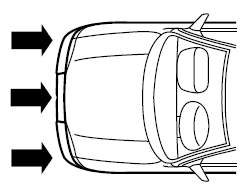
The safety belt pretensioner and airbag SRS are designed to activate when the vehicle sustains longitudinal deceleration sufficient to cause the sensors to close an electrical circuit that initiates pretensioner activation and airbag inflation.
The fact that the pretensioners and airbags did not activate in a collision does not mean that something is wrong with the system. Rather, it means the forces were not of the type sufficient to cause activation. Front airbags are designed to activate in frontal and near-frontal collisions, not rollover, side-impact, or rear-impacts unless the collision causes sufficient longitudinal deceleration.
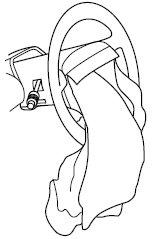
The airbags inflate and deflate rapidly upon activation. After airbag deployment, it is normal to notice a smoke-like, powdery residue or smell the burnt propellant. This may consist of cornstarch, talcum powder (to lubricate the bag) or sodium compounds (e.g., baking soda) that result from the combustion process that inflates the airbag. Small amounts of sodium hydroxide may be present which may irritate the skin and eyes, but none of the residue is toxic.
While the system is designed to help reduce serious injuries, contact with a deploying airbag may also cause abrasions, swelling or temporary hearing loss. Because airbags must inflate rapidly and with considerable force, there is the risk of death or serious injuries such as fractures, facial and eye injuries or internal injuries, particularly to occupants who are not properly restrained or are otherwise out of position at the time of airbag deployment. Thus, it is extremely important that occupants be properly restrained as far away from the airbag module as possible while maintaining vehicle control.
WARNING: Several air bag system components get hot after inflation. Do not touch them after inflation.
WARNING: If the air bag has deployed, the air bag will not function again and must be replaced immediately. If the air bag is not replaced, the unrepaired area will increase the risk of injury in a collision.
The SRS consists of:
• driver and passenger airbag modules (which include the inflators and
airbags)
• seat-mounted side airbags. Refer to Seat-mounted side airbag system later in
this chapter
• safety belt pretensioners
• one or more impact and safing sensors
• a readiness light and tone
• and the electrical wiring which connects the components
• Side curtain airbag system. Refer to Side curtain airbag system later in this
chapter.
• Front passenger sensing system. Refer to Front passenger sensing system later
in this chapter.
• “Passenger airbag off” or “pass airbag off” indicator lamp. Refer to Front
passenger sensing system later in this chapter.
The diagnostic module monitors its own internal circuits and the supplemental airbag electrical system wiring (including the impact sensors), the system wiring, the airbag system readiness light, the airbag backup power, the airbag ignitors and safety belt pretensioners.
See also:
Blind spot mirrors (if equipped)
Blind spot mirrors have an integrated convex spotter mirror built into
the upper outboard corner of the outside mirrors. They are designed to
assist the driver by increasing visibility along the s ...
Remote start
The remote start feature allows you to start the engine from outside the
vehicle. If your transmitter has a
icon, you have remote start. The
remote start feature has an extended operating range ...
Important child restraint precautions
WARNING: Always make sure your child is secured properly in
a device that is appropriate for their height, age and weight.
Child safety restraints must be purchased separately from the vehicle.
Fa ...