
Interior luggage compartment release

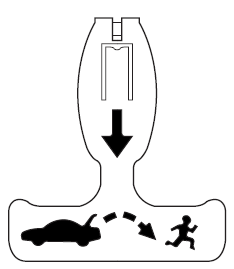
Your vehicle is equipped with a mechanical interior luggage compartment release handle that provides a means of escape for children and adults in the event they become locked inside the luggage compartment.
Adults are advised to familiarize themselves with the operation and location of the release handle.
To open the luggage compartment door (lid) from within the luggage compartment, pull the illuminated “T” shaped handle and push up on the trunk lid. The handle is composed of a material that will glow for hours in darkness following brief exposure to ambient light.
The “T” shaped handle will be located either on the luggage compartment door (lid) or inside the luggage compartment near the tail lamps.
WARNING: Keep vehicle doors and luggage compartment locked and keep keys and remote transmitters out of a child’s reach. Unsupervised children could lock themselves in the trunk and risk injury. Children should be taught not to play in vehicles.
WARNING: Do not leave children, unreliable adults, or animals unattended in the vehicle. On hot days, the temperature in the trunk or vehicle interior can rise very quickly. Exposure of people or animals to these high temperatures for even a short time can cause death or serious heat-related injuries, including brain damage. Small children are particularly at risk.
See also:
Windows and wiper blades
The windshield, rear and side windows and the wiper blades should be
cleaned regularly. If the wipers do not wipe properly, substances on the
vehicle’s glass or the wiper blades may be the cause. ...
Lincoln MKZ Dynamic Driving Technologies
The new MKZ offers Lincoln Drive Control as standard. Lincoln Drive Control
is an automatic system that delivers an ideal balance of a smooth ride with
confident handling as it intuitively respond ...
Resuming the set speed
Press and release RES/CNCL. This will automatically return the vehicle
to the previously set speed. The set speed will display continuously in
the message center while ACC is active.
Note: Resu ...