
Gauges
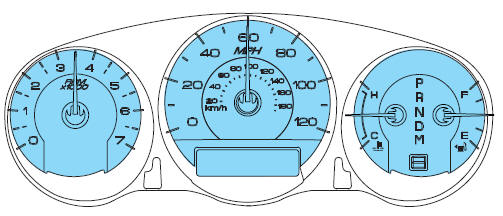
Gauges
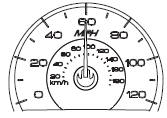
Speedometer: Indicates the current vehicle speed.
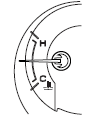
Engine coolant temperature gauge: Indicates engine coolant temperature. At normal operating temperature, the needle will be in the normal range (between “H” and “C”). If it enters the red section, the engine is overheating. Stop the vehicle as soon as safely possible, switch off the engine and let the engine cool.
WARNING: Never remove the coolant reservoir cap while the engine is running or hot.
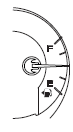
approximately how much fuel is left in the fuel tank (when the ignition is in the on position). The fuel gauge may vary slightly when the vehicle is in motion or on a grade.
The FUEL icon and arrow indicates which side of the vehicle the fuel filler door is located.
Refer to Filling the tank in the Maintenance and Specifications chapter for more information.
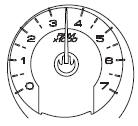
Tachometer: Indicates the engine speed in revolutions per minute.
Driving with your tachometer pointer continuously at the top of the scale may damage the engine.

Odometer: Registers the total miles (kilometers) of the vehicle.
Refer to Message center in this chapter on how to switch the display from Metric to English.
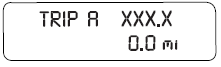
Trip odometer: Registers the miles (kilometers) of individual journeys.
Press and release the message center INFO button until TRIP A or TRIP B appears in the display (this represents the trip mode). Press and hold the RESET button for two seconds to reset.
See also:
Replacement of Integrated Keyhead Transmitters and Coded Keys
Note: Your vehicle comes equipped with two integrated keyhead
transmitters.
The integrated keyhead transmitter functions as both a programmed
ignition key that operates all the locks and starts t ...
Interior
"We have made the new MKS interior much more inviting and engaging, with new
capacitive controls and MyLincoln Touch," said Wolff. "The previous MKS was very
linear and horizontal. No ...
Optional settings – these settings can be changed
• Vehicle speed is limited to 80 mph (130 km/h). Visual warnings are
displayed followed by a chime when the vehicle speed has reached
80 mph (130 km/h).
• Visual warnings are displayed followed b ...