
Exterior
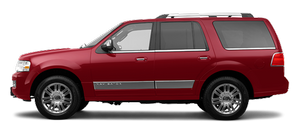
The design of the roof and front doors was carried over from the previous model. But fresh bodywork elsewhere embellishes the original design and is said to offer better aerodynamics, cleaner surfaces and a more dramatic stance. Lincoln’s signature grille consists of vertical argent vanes. Torsional rigidity of the frame is 70 percent better than before, and vertical bending has improved by 67 percent. About 10 feet of the new frame is hydroformed. Standard and optional tires both measure 18 inches in diameter. Options include a power moonroof and chrome wheels.
The front edge of the hood has been raised 4 inches, which makes it possible to see the vehicle’s corners. The frame rails have been lowered by 2 inches, and the rear floor pan has dropped 9 inches. Lowering the bumper beam by 2 inches provides better compatibility with other vehicles in a collision. 4WD models have been lowered by an inch to be on par with their 2WD counterparts. The vehicle also lowers itself by an inch when the ignition is turned off to allow easier entry and exit.
High-intensity-discharge headlights, a power liftgate and power running boards are installed on the Ultimate model. The running boards extend outward by 4 inches when the door is opened and they retract automatically when the door is closed.
See also:
Second-row non-adjustable head restraints
Your vehicle is equipped with second row outboard head restraints that
are non-adjustable.
WARNING: To minimize the risk of neck injury in the event of a
crash, the driver and passenger occupants ...
Crafted, natural, comfortable
Standard 12-way adjustable front seats, adjustable pedals and power
tilt/telescoping steering wheel help accommodate a wide range of drivers.
The leather surfaces for the first two rows of seating ...
CTA and Reverse Sensing System (RSS) interaction
CTA works along with the Reverse Sensing System (RSS) (if equipped).
Become familiar with the warning tones of both systems. ...