
Setting adaptive cruise control
1. Press and release ON. The
message center will display the
gray  ACC indicator light, current
gap setting and SET.
ACC indicator light, current
gap setting and SET.
2. Accelerate to the desired speed.

3. Press SET upward and release.
The vehicle speed will be stored in the memory and the message center
will display a green  ACC indicator
light, current gap setting and
desired set speed.
ACC indicator
light, current gap setting and
desired set speed.
4. Take your foot off the accelerator pedal.
5. A lead vehicle graphic will
illuminate if there is a vehicle
detected in front of you.

Following a vehicle
WARNING: When following a vehicle in front of you, the vehicle will not decelerate automatically to a stop, nor will the vehicle always decelerate quickly enough to avoid a collision without driver intervention. Always apply the brakes when necessary. Failing to do so may result in a collision, serious injury or death.
When a vehicle ahead of you enters the same lane or a slower vehicle is ahead in the same lane, the vehicle speed will adjust automatically to maintain a preset gap distance. The distance setting is adjustable, refer to Setting the gap distance in this section.
The lead vehicle graphic will be illuminated.
The vehicle will maintain a constant distance between the vehicle ahead until:
• The vehicle in front of you accelerates to a speed above the set speed.
• The vehicle in front of you moves out of your lane or out of view.
• The vehicle speed falls below 16 mph (26 km/h).
• A new gap distance is set.
The vehicle brakes will be automatically applied to slow the vehicle to maintain a safe distance between the vehicle in front. The maximum braking which is applied by the ACC system is limited and can be overridden by the driver applying the brakes.
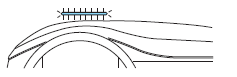
If the ACC system predicts that its maximum braking level will not be sufficient, an audible warning will sound while the ACC continues to brake. This is accompanied by a heads-up display; a red warning bar illuminating on the windshield. The driver should take immediate action.
Note: The brakes may emit a sound when they are being modulated by the adaptive cruise control system.
Note: The brakes may emit a sound when they are being modulated by the adaptive cruise control system.
WARNING: Adaptive cruise control only warns of vehicles detected by the radar sensor. In some cases there may be no warning or the warning may be delayed. The driver should always apply the brakes when necessary. Failing to do so may result in a collision, serious injury or death.
See also:
Tire wear
When the tread is worn down to
1/16th of an inch (2 mm), tires must
be replaced to help prevent your
vehicle from skidding and
hydroplaning. Built-in treadwear
indicators, or “wear bars”, wh ...
Getting the services you need
Warranty repairs to your vehicle must be performed by an authorized
dealer. While any authorized dealer handling your vehicle line will
provide warranty service, we recommend you return to your se ...
Mud and water
If you must drive through high water, drive slowly. Traction or brake
capability may be limited.
When driving through water, determine the depth; avoid water higher
than the bottom of the wheel ...