
Looks
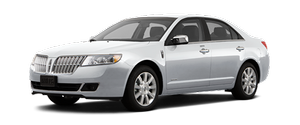
Even though the MKS is a comfortable car with a refined interior and a lot of standard features, the first thing people will notice is its bold looks. The profile is vanilla bland, but both the snarling front end and the Maserati-influenced rear will turn heads and make people say, "That's a Lincoln?"
While I was testing this car, I had people stop me to ask if I was driving a new Cadillac. Another passerby knew it was a Lincoln and was impressed, again comparing it to Cadillac's latest CTS in a favorable way.
You can't escape the huge grille up front no matter how hard you try; the chrome-covered plastic grille is indeed the new "look" for Lincoln. It's doubtless the product of an ever-escalating grille war that's pitting automakers against one another in an attempt to design the largest, most in-your-face bumper-jewelry imaginable.
The MKS kind of reminds me of the Cheshire Cat from "Alice in Wonderland" — a comparison I'm not the first to mention; I won't be the last, either. Regardless, it's distinctive without going too over the top, unlike the new Cadillac CTS and its excessively blinged-out grille.
The back end hasn't received nearly as much attention in the press as the front has, but if you put it side by side with Maserati's Quattroporte sedan, you'll see where its inspiration lies. Considering the exterior dimensions of the MKS, its two ends work well together to complement the sedan's sheer size. It comes in at 204.1 inches long, which is longer than a Buick Lucerne and even many three-row crossovers. Basically, this new look will lead to new shoppers, without the whippersnapper in the Lincoln lineup turning off the older set.
See also:
Driving while you tow
When towing a trailer:
• Do not drive faster than 70 mph (113 km/h) during the first 500 miles
(800 km) of trailer towing and don’t make full-throttle starts.
• Turn off the speed control. The ...
Changing rear window wiper blade
The rear wiper arm is designed without a service position. This reduces
the risk of damage to the blade in an automatic car wash.
To replace the wiper blade:
1. Grab the wiper arm with one
h ...
Power side view mirrors
WARNING: Do not adjust the mirror while the vehicle is in
motion.
To adjust your mirrors:
1. Rotate the control clockwise to
adjust the right mirror and rotate
the control counterclockwise ...