
Types of booster seats
There are generally two types of belt-positioning booster seats: backless and high back. Always use booster seats in conjunction with the vehicle lap/shoulder belt.
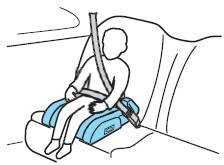
• Backless booster seats
If your backless booster seat has a removable shield, remove the shield. If a vehicle seating position has a low seat back or no head restraint, a backless booster seat may place your child’s head (as measured at the tops of the ears) above the top of the seat. In this case, move the backless booster to another seating position with a higher seat back or head restraint and lap/shoulder belts, or consider using a high back booster seat.
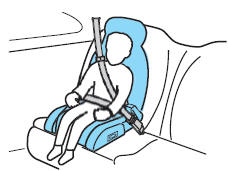
• High back booster seats
If, with a backless booster seat, you cannot find a seating position that adequately supports your child’s head, a high back booster seat would be a better choice.
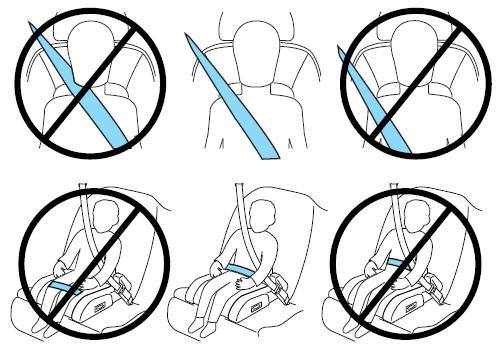
Children and booster seats vary in size and shape. Choose a booster that keeps the lap belt low and snug across the hips, never up across the stomach, and lets you adjust the shoulder belt to cross the chest and rest snugly near the center of the shoulder. The drawings below compare the ideal fit (center) to a shoulder belt uncomfortably close to the neck and a shoulder belt that could slip off the shoulder. The drawings below also show how the lap belt should be low and snug across the child’s hips.
If the booster seat slides on the vehicle seat, placing a rubberized mesh sold as shelf or carpet liner under the booster seat may improve this condition. Do not introduce any item thicker than this under the booster seat. Check with the booster seat manufacturer’s instructions.
See also:
Global open windows
Press and hold to begin opening
the two front windows and venting
the panoramic roof (if equipped).
• The control can then be released
and the windows and panoramic
roof will complete the ...
Overview
Lincoln introduced its first hybrid - the new 2011 Lincoln MKZ Hybrid - a
premium midsize car poised to be the most fuel-efficient luxury sedan in
America. Ford Motor Company - America's largest d ...
Peace of mind
•Remote start
•Wheel locks
•Vehicle security systems
•Locking fuel plug for capless fuel system
*Ford Licensed Accessories (FLA) are warranted by the accessory
manufacturer’s warranty. Ford Lice ...