
Second generation (2003–2006)
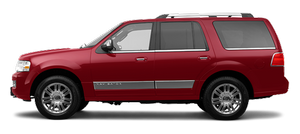
The Navigator was updated in 2003, along with the Ford Expedition, on the new Ford U platform. The interior was also substantially revised to bring it up to the level expected by luxury buyers. Some ingenious features debuted with this redesign, including power-deployable running boards that deploy when a side door is opened, a power liftgate, and a power folding third row seat.
Tire-pressure monitoring was made standard for 2004, with Roll Stability Control an option, and the mid-level Premium trim line was deleted. Along with a light facelift the powertrain was revised for 2005, with the DOHC 5.4 L V8 being replaced by a new SOHC 3-valve design borrowed from the F-150, driving the wheels through a new ZF Friedrichshafen AG-sourced 6-speed automatic transmission. The stability system was now standard on all models. An Elite package for the Ultimate trim includes a THX audio system, rear-seat entertainment, and HID headlights for 2006, the last year of this generation.
See also:
INTERIOR
The 2010 MKZ's redesign included many changes to the interior, which is
clean-looking and clutter-free. I liked the delicate swooshes of real wood
accenting the interior doors and the no-nonsense ...
Memory feature
The integrated keyhead transmitter (IKT) allows you to recall the
memory seat and mirrors feature.
Press to automatically move the
seat and mirrors to the desired
memory position.
Note: The s ...